Books > Learner Autonomy (Cambridge Elements)
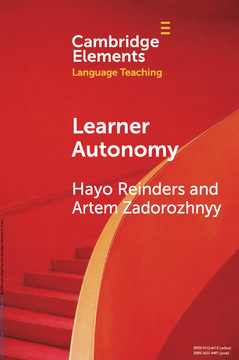
Reinders, H. & Zadorozhnyy, A. (2026). Learner Autonomy. Cambridge Elements. Cambridge University Press.
This Element provides a concise, research-informed, and practice-oriented overview of learner autonomy in language education. It examines how teachers can create conditions that foster greater independence, self-regulation, and motivation among learners in both face-to-face and digital environments, both inside and outside the classroom. While the concept of autonomy has long been recognised in applied linguistics, many teachers still find it difficult to translate theory into everyday practice. Learner Autonomy addresses this gap by offering clear principles, classroom strategies, and examples across diverse contexts.
The book situates autonomy within current perspectives on self-regulated learning, motivation, and socio-cultural theory, and highlights its renewed relevance in an era of hybrid learning and AI-mediated instruction. Each chapter links concise summaries of key research findings with concrete practices teachers can implement immediately, from designing choice-rich tasks and reflective routines to integrating learner-generated goals, peer mentoring, and digital scaffolds that support self-direction.
Combining over two decades of research and teacher-development experience, this Element demonstrates that autonomy is not an abstract ideal but a learnable, teachable competence that can be systematically cultivated through instructional design and day-to-day classroom practice. It concludes with a framework to help educators plan, evaluate and sustain autonomy-supportive teaching across different institutional and cultural contexts.
- Understand current conceptualisations of learner autonomy as both an individual and social capacity, shaped by ecological and complexity perspectives.
- Recognise the psychological, motivational, and emotional dimensions of autonomy and how these can be supported through everyday classroom practices.
- Design autonomy-supportive tasks that foster reflection, choice, and responsibility, and apply these in both face-to-face and digital learning contexts.
- Integrate technology and AI tools in ways that promote agency, critical awareness, and ethical use of digital resources.
- Support learners in extending their autonomy beyond the classroom through guided exploration of informal, hybrid, and online learning spaces.