Books > AI and Transformative Technology
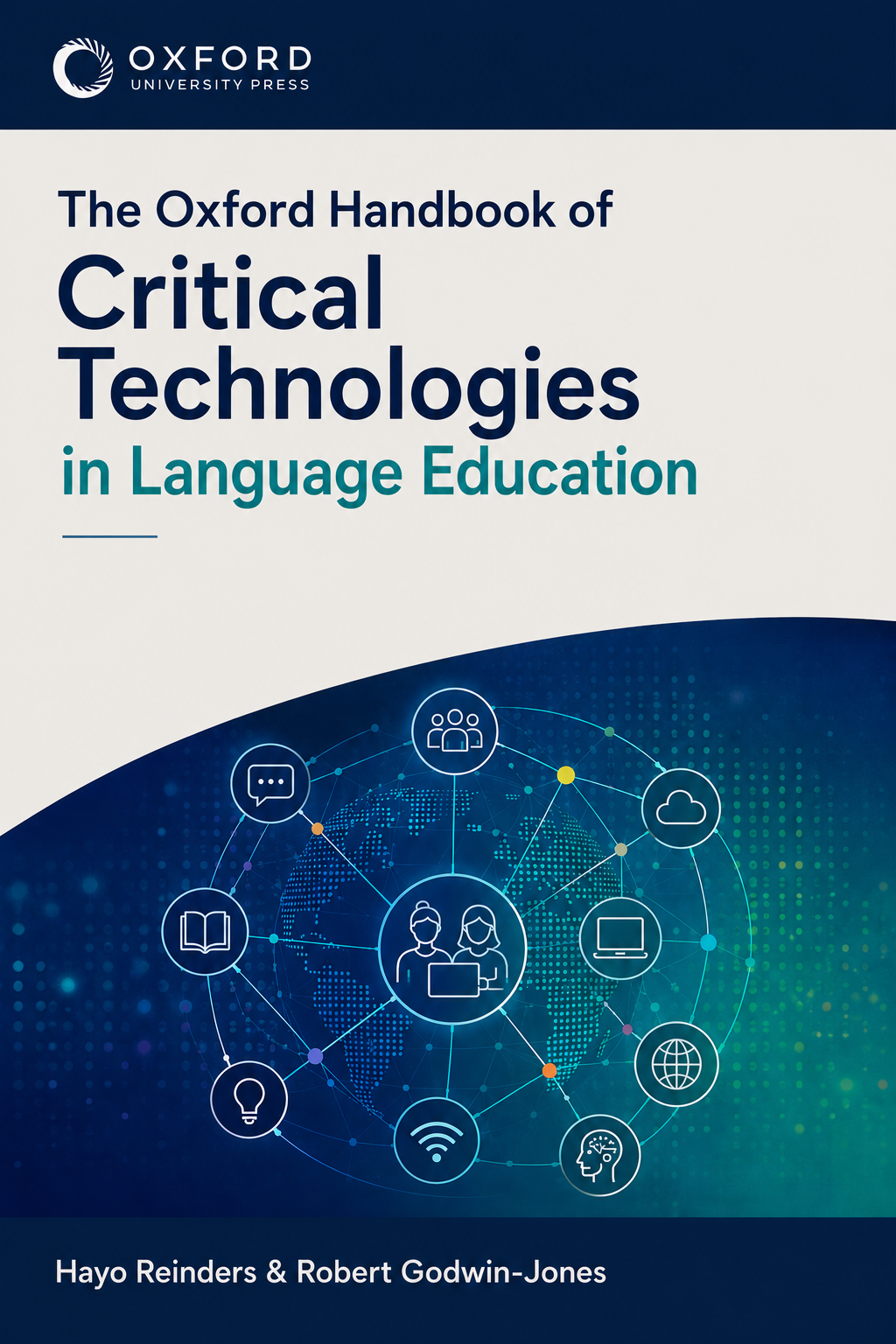
Reinders, H. & Godwin-Jones, R. (2025). Critical learning technologies. Oxford University Press (forthcoming).
1 What is this book about?
If you've picked up this book, you probably have many questions about the role of technology in language education. Some of these questions may be quite fundamental and relate to the changing nature of learning and teaching and the impact this may have on you, your learners, and the wider education system. They may include concerns about algorithmification (the increased reliance on often hidden technology), techno-solutionism (the belief that all educational challenges can be fixed by technology), or learner overreliance on AI at the expense of independent thinking. Or perhaps you wonder how (or if) benefits like personalisation, reduced administrative workload, or immediate learner feedback can be achieved in practice. These are examples of critical questions. Of course, being critical does not mean being dismissive or negative but involves the capacity to ask probing questions about the purposes, assumptions, and consequences of technology use in education. Criticality invites us to look beyond whether a tool works in a narrow technical sense, and to consider who benefits from it, who may be disadvantaged, and what broader social, cultural, and ethical issues are at play. As recent scholarship highlights, digital tools mediate power, access, and identity in classrooms, and their adoption is never neutral but always shaped by underlying assumptions and interests.
Recognising this dimension of criticality helps frame the discussion that follows. Rather than approaching technology as either a promise to be embraced or a threat to be resisted, we encourage you to see it as a complex field that requires careful, balanced reflection. With this in mind, the chapters ahead aim to provide you with both a clear-eyed view of the benefits and limitations of technology in language learning and teaching (TLLT from now on) and practical tools to help you navigate it with confidence.
In this chapter we do this by first taking a step back and reviewing the changes that have happened in recent years. Among many other developments, we have seen a rise in online and blended learning, the emergence of immersive tools such as augmented and virtual reality (AR and VR), the increased use of data and analytics, and of course the arrival of generative artificial intelligence (we will refer to this as AI from now on). Together, these technologies are rapidly and significantly impacting all aspects of education. Further down in this chapter we will explore these developments and their impact.
In Chapter 2 we take stock of what we have learned about the effects of TLLT. We explore examples of successful and unsuccessful uses of technology. Educational history is replete with well-intentioned but poorly executed or poorly supported initiatives that did not achieve their intended outcomes. We draw from this a number of lessons that translate into generalisable questions any educator can ask when confronted with technology-related change.
However, not all drawbacks of technology are immediately visible. A significant number of risks are hidden to teachers, either because most of us lack the knowledge to understand how the technology works or because in many cases the consequences of technological developments cannot be fully understood yet. In chapter 3 we deal with such ‘wicked problems’ (problems to which not only we do not have the answers but often don't have the right questions to ask to find the answers either; Hays & Reinders, 2018). We offer advice on how to spot such inherent dangers and the risk of technology leading to unintended consequences. We deal with issues such as bias and privacy, as well as the exploitation of learner data and the effects of unequal access to technology. We give you a number of tools to help you critically consider the impact technology will have in your specific context and ways to mitigate against them.
Chapter 4 questions some of the claims that have been made for the pedagogical potential of technology to personalise instruction and feedback. We consider the nature of personalization and the different forms it can take. We look at examples of how supposedly helpful and individualised assistance can in some cases be quite limiting and even detrimental. We offer you a toolkit for questioning the sometimes bold claims made about new technologies. We also offer suggestions for how you can maximise the technology’s affordances, or potential benefits, by considering the best ways to integrate new tools into your specific pedagogical context.
Chapter 5 moves from what is personalised to how learning becomes hybrid. Hybridity includes blended and flipped learning, but also the broader coupling of human judgement with platform logics, analytics, mobile tools, and generative AI. These shifts raise questions about control and agency: who shapes learning pathways, how progress is judged, and whose assumptions guide recommendations? Chapter 5 examines tensions between efficiency and deeper learning, and argues for pedagogical coherence so hybrid arrangements serve meaningful language use rather than fragmenting it.
Chapter 6 turns to self-determined learning under hybrid conditions. Although language education has long valued learner autonomy and informal learning, today’s technologically mediated environments recommend, evaluate, and steer learning in new ways. Using heutagogy as a lens, Chapter 6 shows how autonomy must be reinterpreted amid abundance, algorithmic mediation, and distributed regulation. It introduces Hybrid-Regulated Learning to explain how responsibility and decision-making are shared across learners, teachers, and technologies, and offers practical ways to prepare and support learners for self-determined learning.
Chapter 7 asks how technology can serve human purposes in language education rather than quietly redefining them. It argues that personalisation, hybridity, and autonomy only deliver educational value when guided by explicit human values, such as voice, relationships, meaning-making, and ethical responsibility. The chapter defines what “humanising” technology entails, then shows how teachers can repurpose tools and data to support dialogue and professional judgement. It concludes with practical humanising moves that protect agency, attention, and wellbeing so innovation strengthens, rather than erodes, the human dimensions of language learning.
Building on the previous chapters’ foundation,
Chapter 8 identifies pedagogical pathways for everyday classroom practice, including the teaching of digital literacies, designing activities that foster well-being, and involving learners in interpreting their own performance data. It also includes such activities as ensuring lessons balance digital and non-digital modes, ensuring equitable access, and helping learners develop transferable skills.
Identifying potential benefits of a technology goes beyond looking at learning outcomes. As discussed in Chapter 9, there may be benefits at the administrative level, a reduction in costs, or better alignment with national educational policies. Furthermore, consideration needs to be given to whether a particular tool will help to increase efficiency (the achievement of goals with a minimum number of resources required) or effectiveness (the maximising of intended outcomes with a given set of resources). Many teachers experience a lack of agency when technology use is prescribed at the institutional level, especially where benefits are limited to efficiency gains. Other barriers include inadequate professional development for teachers, lack of supportive infrastructure and resources, insufficient integration of pedagogy with assessment frameworks, and the absence of readiness to adapt and refine methods through reflective practice. We provide some suggestions to help teachers weigh different benefits against their costs.
In the final chapter, we consider how teachers and learners can develop the capacity for critical engagement with technology as well as the practical skills necessary to realise its affordances while avoiding its hidden dangers. We frame these suggestions by returning to the three concepts of hybridity, heutagogy and humanization at the level of the learner, the teacher and the institution.