Books > Nordics
Sundqvist, P., Sylvén, L. & Reinders, H. (Eds.) (2027). Innovation in language learning and teaching: The case of the Nordics. Palgrave Macmillan (forthcoming).
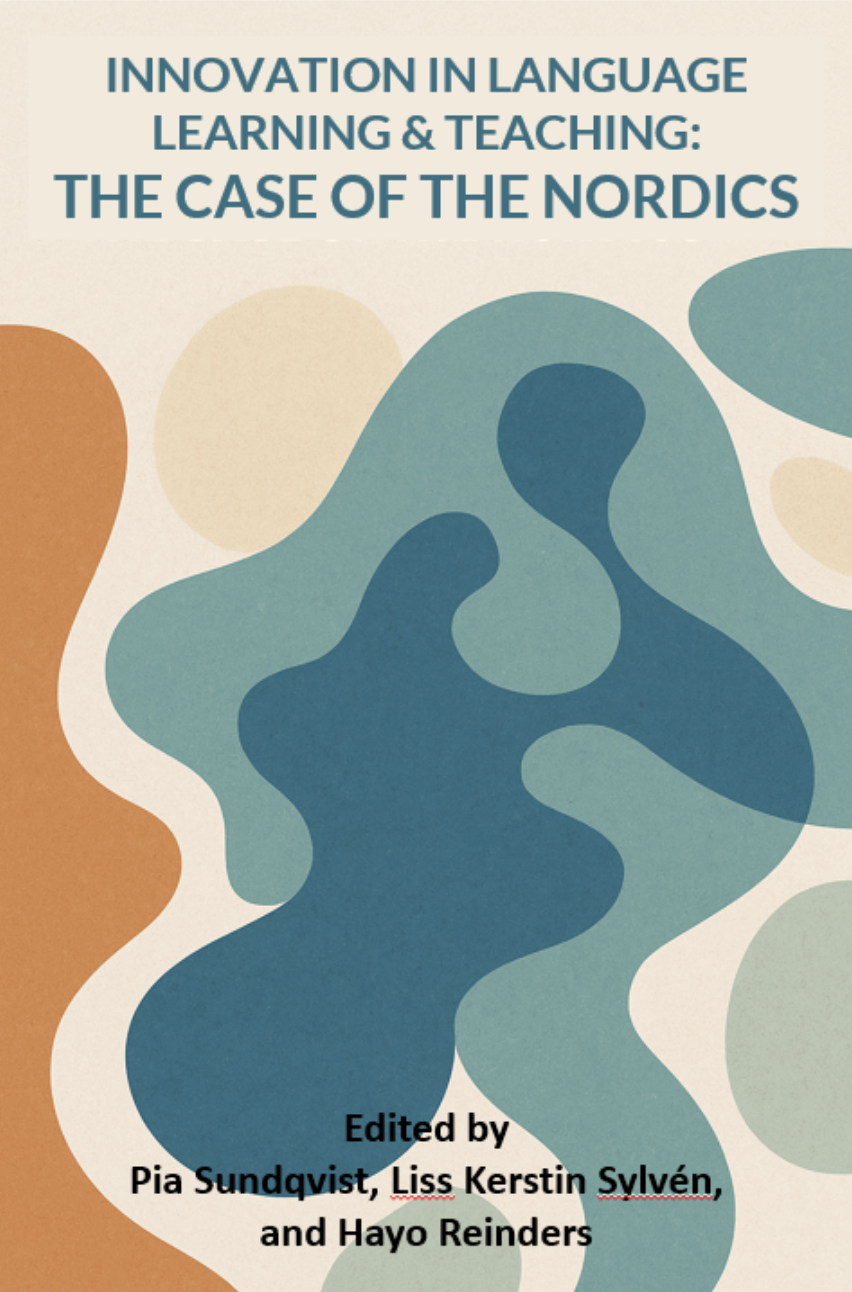
In this book the aim is to shed light on this region with its fascinating linguistic landscape and long tradition of language learning and teaching research. People from the Nordics—Denmark, Finland, Iceland, Norway, Sweden, including relevant territories—have always needed to be knowledgeable in other languages, since their respective majority languages are spoken by a limited number of individuals. This volume aims to showcase the state-of-the-art of current research on language learning and teaching in the Nordics.
As is commonly known, context is always important in language research. With this volume, we want to highlight what is happening in this specific part of the world, adding a new case to the book series "Innovation in Language Learning and Teaching". It can be noted that the Nordic region constitutes a well-resourced environment characterized by wide and easy access to the latest technologies, which has impacted language research over the past twenty years. For example, it is probably not a coincidence that early research on informal language learning and connections between digital practices and language learning originate from this part of the world, such as studies on extramural English and links between online gaming and language learning. The region differs in many respects from other areas of Europe and the rest of the world, and with this book, we want to shed light on the current state of the research.
Description
Innovation in language learning and teaching is typically shaped by a complex interaction of global and local forces that influence language policies, curriculum design, and the adoption of new teaching methods, not to mention the use of technology. In this book, the concept of innovation is broadly interpreted and it can come in any way, shape, or form. It may be related to policy, practice(s), research methodologies, and theory, to give some examples.
Language education in the Nordic countries rests on a shared foundation of equality, inclusion, and strong public schooling. From the early years, language learning is closely tied to broader educational values such as democracy, participation, critical thinking, and the idea that all students, regardless of background, should have access to rich linguistic and cultural resources. Teachers are typically highly educated, usually with university degrees and specialized training in language pedagogy. Notably, in the Nordic countries, it is common to talk about language "didactics" (from German Didaktik) rather than language pedagogy. It must be mentioned that the scope of Didaktik/didactics in the Nordics is wider than the Anglophone understanding of the concept didactics. Due to the different understandings across languages, when discussing the typical Nordic conceptualization of Didaktik in English-mediated texts, the terms subject-specific education (cf. Danish and Norwegian fagdidaktikk, Swedish ämnesdidaktik) and language-specific education (cf. e.g., Swedish språkdidaktik and Norwegian språkdidaktikk) are often used. Language-specific education is rooted in academic disciplines specializing in different school subjects. Moreover, language-specific research issues are typically connected with conditions for teaching languages, but also with questions having to do with individual students' language learning in different environments, such as in formal (in school/intramural) as well as in informal (outside school/extramural) contexts.
As language teachers in the Nordic countries enjoy considerable professional autonomy, it allows them to adapt national curricula to local contexts, choose materials, and develop communicative, learner‑centered approaches in their classrooms. For this reason, many innovative studies within the field of language-specific education evolve from the Nordic region. It has been fertile ground for exploring new teaching methods, research methods, research topics, and so forth. Some of this research is presented in this book.
Further, from an international perspective, it might not be commonly known that all five countries place strong emphasis on their national languages as carriers of culture, identity, and social cohesion. Thus, Danish, Icelandic, Finnish, Norwegian, and Swedish are taught not only as tools for communication, but also as gateways to literature, history, and civic life. Reading and writing skills are systematically developed too, and literature (both national classics and contemporary works) plays a central role as well. At the same time, the Nordic region is increasingly multilingual: immigration and globalization have brought many different new languages into classrooms. Policy documents in all countries generally present multilingualism as a resource rather than a problem, and there are various forms of support for students' first languages, though the scope and implementation differ from one country to another. This type of situation has led to a great deal of research on the role of multilingualism in additional language learning and in teaching languages, which is yet another topic addressed in this volume.
Foreign language education in the Nordics is dominated by English, which is introduced early and is compulsory for all students throughout much of compulsory education. English tends to be taught communicatively. This school‑based learning is reinforced by the media environment. Foreign films and programs are generally subtitled rather than dubbed, and young people are heavily exposed to English through, for example, gaming, social media, and streaming services. As a result, English proficiency is generally high across the region. Research on informal, out-of-school extramural English stems from Sweden and together with such research from its neighboring countries, extramural language research has a strong foothold in the Nordics. Innovative perspectives on extramural language research are presented in this book. Content and language integrated learning (CLIL) is used in schools, and English-medium instruction (EMI) is common in higher education. These are other important topics reflected in this book.
Besides English, students encounter additional languages in ways that reflect each country's history and position in Europe. German, French, and Spanish are the most common further foreign languages taught in Denmark, Norway, and Sweden, usually offered as optional subjects from lower secondary school. Finland presents a somewhat different picture: it is officially bilingual, with Finnish and Swedish both holding official national language status. Depending on their mother tongue, pupils must learn the other national language in addition to English, which shapes the overall structure of language education in Finland. Other foreign languages such as German, French, or Spanish are offered too. Iceland, as a small language community, combines a strong protective stance toward Icelandic with compulsory English and Danish, reflecting historical ties and its position in the Nordic region.
Nordic cooperation and geographical proximity also influence language education, particularly in the three Scandinavian countries: Danish, Norwegian, and Swedish are closely related and to a large extent mutually intelligible. At the same time, increasing linguistic diversity in Scandinavia has led to more explicit attention to second language teaching (e.g., Swedish as a second language) and support for students' home languages in mother-tongue classes, although the extent and effectiveness of these measures differ.
Overall, language education in the Nordic countries reflects a balance between protecting and cultivating national languages, promoting high‑level competence in English, and opening doors to other European and world languages. The systems share a commitment to inclusive, communicative, and literacy‑rich language teaching within comprehensive, publicly funded schools. Yet they also diverge in the role of bilingualism (as in Finland), the strength of particular foreign languages (such as Spanish), the prominence of neighbor language policies (especially in Norway), and the ways they respond to increasing multilingualism and migration.
Finally, compulsory education is publicly funded and free to attend in the Nordics. Higher education is tuition-free or available to a low cost for domestic students in all five countries, also traditionally free for EU/EEA students.
With this description as a background, it is worth mentioning that the Nordic countries have experienced many changes in recent years, not least because of increased migration following the 2015 refugee crisis and the war in Ukraine. Technological advancements and the role of digitization in schools have also influenced language education extensively.
Some of the questions this book answers include:
- What is the role of equity in language education in the Nordics?
- What innovative practices can be seen in English-mediated instruction in higher education?
- What are some new perspectives on informal extramural learning in the Nordics?
- What affordances and challenges are there in collaborative Action Research?
- How do pre-service English teachers view their education?
- What implications and lessons can be drawn from the experiences in the Nordics for other countries and regions?
- What are the region-specific variables that facilitate or inhibit the dissemination of innovation?
This book brings together experiences at all levels of language education in the Nordics. The chapters bring together widely respected and well-known academics from the Nordics, but also early career researchers. Together, they cover many interesting aspects of innovation in language learning and teaching in this northern region of Europe.
Each chapter deals with innovation and is carefully structured to provide enough background information to understand its specific context, while drawing broader implications for scholars in different contexts or countries.
Table of Contents
Introduction
- A brief look at language education in the Nordics — Pia Sundqvist, Liss Kerstin Sylvén, Hayo Reinders
Part I: Extramural, Informal, and Mediatized Language Learning
- Researching Extramural Swedish in Sweden: The case of immigrant learners' intentional informal language learning — Denise Bergström, Agnes Strandberg (Luleå University of Technology)
- Extramural English and the changing landscape of language learning in Finland — Lea Meriläinen (University of Eastern Finland)
- The role of upper secondary level Norwegian teachers towards bridging intra- and extramural English — Alison Rød (University of Bergen)
- Escapist extramural English: Why learners choose language as a tool to escape reality — Nasrin Ulfat (University of Oslo)
- Mediatization, informal language learning, and language ideologies of multilingual teenagers in Denmark — Aisara Yessenova (University of Copenhagen)
- Early extramural English and academic vocabulary — Nicole Louise Busby (Norwegian University of Science and Technology)
Part II: Digital, Immersive, and Technology‑Enhanced Innovation
- Extensive reading and teaching of vocabulary learning strategies to young EFL learners — Riikka Ullakonoja (University of Jyväskylä)
- Exploring the (in)authenticity of virtual reality-based simulation activities for L2 learning — Teppo Jakonen (University of Jyväskylä)
- Mobile digital ecologies and recently arrived refugee adolescents: Connecting extramural practices with formal language learning in Finnish preparatory classrooms — Linda Molin-Karakoc (University College London)
- Agency in writing instruction: Active learning practices in student-centered classrooms — Marie Nordmark (Dalarna University)
Part III: Multilingual Classrooms, Migrant Learners, and Inclusive Practices
- Specialised competencies and teachers' needs for professional development for teaching Icelandic as a second language — Branislav Bédi (The Árni Magnússon Institute for Icelandic Studies), Renata Emilsson Pesková (University of Iceland)
- Innovating interdisciplinary subject literacy: Translanguaging in academic Swedish for internationally educated teachers — Sofie Johansson, Lina Larsson (University of Gothenburg)
- Language learning at work: insights from a Swedish language café for international staff — Linda N. Narfström, Ines Nikšić (University of Skövde)
- The design and innovative potential of the board game B.Eyja for adult learners of Icelandic — Lara Hoffmann (University of Iceland), Artëm Ingmar Benediktsson (University of Iceland), Fanny Sissoko (Reykjavík City Library)
Part IV: Teacher Education, Professional Learning, and Research Methodologies
- Collaborative action research in English L2 education — Torunn Synnøve Skjærstad (University of Inland Norway)
- The impact of elective English classes in Swedish upper secondary school on EMI lecture comprehension — Joseph Siegel, Maria Kuteeva, Aki Siegel (Stockholm University)
- Bridging formal and informal language learning: Teachers' evaluation of an innovative professional development course — Mehmet Sercan Uztosun (Norwegian University of Science and Technology)
Concluding Remarks
- The horizon: The Nordics and beyond — Liss Kerstin Sylvén, Pia Sundqvist, Hayo Reinders