Books > Kazakhstan
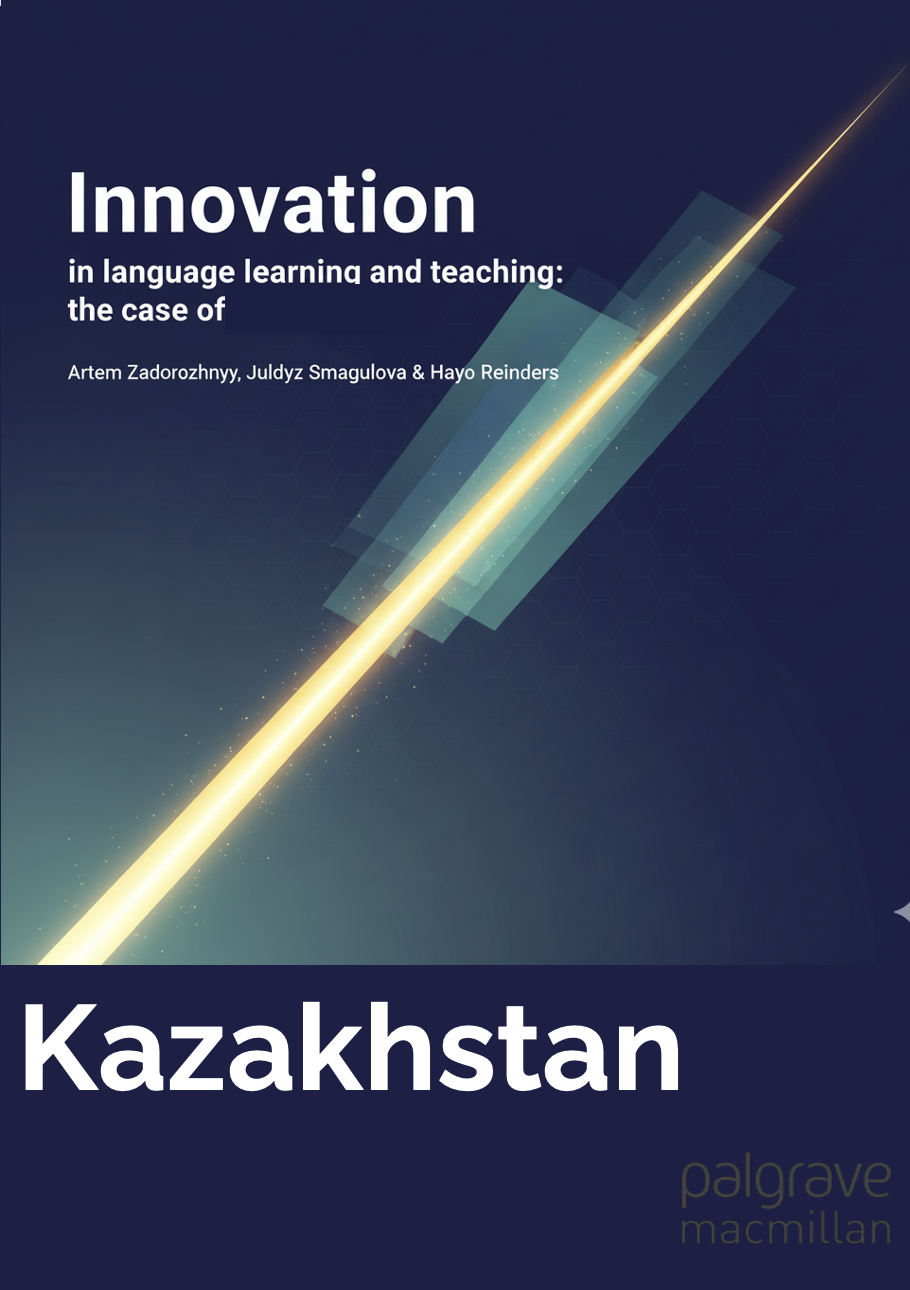
Zadorozhnyy, A., Smagulova, J. & Reinders, H. (Eds.) (2027). Innovation in language learning and teaching: The case of Kazakhstan. Palgrave Macmillan (forthcoming).
Description
This volume offers a critical and timely examination of the rapidly evolving landscape of language education in Kazakhstan. Situated within a complex polycentric linguistic environment where Kazakh, Russian, and English intersect, the book investigates the processes, drivers, and impacts of innovation in Kazakhstani language education, bringing together perspectives from policy, practice, and scholarship. It also positions Kazakhstan as a key Central Asian context that continues to negotiate its post-Soviet realities through language and education reforms.
In recent years, Kazakhstan has undertaken major reforms to modernise its education system, promote multilingualism, and align language teaching with international standards. This volume documents both the successes and the challenges of these efforts, providing a comprehensive resource for educators, policymakers, and researchers interested in advancing language education innovation in Kazakhstan and comparable settings. To frame these developments analytically, the volume approaches innovation not simply as the introduction of new policies, tools, or teaching techniques, but as a situated process of educational change. Innovation is, therefore, understood as purposeful, context-sensitive transformation in language education that may occur at the levels of policy, curriculum, pedagogy, assessment, technology, institutional practice, and learner experience. Rather than viewing innovation as a linear, uniformly implemented, or inherently beneficial process, the volume proposes to examine how innovations are interpreted, adapted, resisted, and reworked by teachers, students, institutions, and policymakers within Kazakhstan's multilingual and post-Soviet educational context. It allows the chapters to speak to one another across diverse topics, from language policy enactment and curriculum reform to EMI/CLIL, inclusive education, and digital pedagogy. In doing so, the volume builds its theoretical contribution by showing how innovation travels across levels, and how it is reshaped by language ideologies, institutional constraints, teacher agency, learner experiences, and unequal access to resources.
Given the rapid developments across the Central Asian region, it is important to synthesise research on language education at this historical juncture. To bridge the gap between theory and practice, each chapter includes a dedicated section on pedagogical implications explicitly grounded in the Kazakhstani context, and, where appropriate, considers the transferability of these implications to comparable multilingual and post-Soviet educational settings. By highlighting both the adaptation of global best practices and the development of locally grounded solutions, the book offers actionable insights for teachers, policymakers, and curriculum developers. Ultimately, it serves as a vital resource for understanding how educational innovation can be implemented sustainably and equitably in Kazakhstan and similar multilingual, post-Soviet contexts, while raising global awareness of the distinctive and evolving Central Asian reality. Across the volume, innovation is analysed through four interrelated dimensions: policy and curricular innovation, pedagogical and assessment innovation, multilingual and identity-related innovation, and digital/technological innovation. These dimensions provide the conceptual architecture for the book's three thematic sections and are revisited in the concluding chapter to identify cross-cutting patterns, tensions, and implications.
The proposed volume opens with an introductory chapter, which lays out the necessary background and context for the ensuing discussions. Following this foundation, the proposed volume is structured around three core themes. The first part explores the intersection of top-down language policies and lived classroom realities, examining how curricular reforms, shifting teacher ideologies, and textbook developments shape educational outcomes, inclusive practices, and linguistic identities within Kazakhstan's polycentric environment. The second part shifts the focus to English-Medium Instruction (EMI) and Content and Language Integrated Learning (CLIL), illustrating the complexities of teaching academic disciplines in a foreign language. This section highlights how students, educators, and institutions navigate translanguaging practices and policy constraints within trilingual educational frameworks. Finally, the third part addresses the rapid integration of technology into language education, evaluating both the affordances and challenges of modern digital tools. By covering emerging practices such as AI-assisted assessment, virtual reality environments, and online shadow education, this final section demonstrates how digitalization is fundamentally reshaping pedagogical strategies and student engagement. Finally, the volume closes with a concluding chapter that synthesizes the lessons learned across all three sections and draws key implications for the future of language education in the region by identifying what Kazakhstan's experience contributes to wider debates on innovation in Central Asian, post-Soviet, and multilingual education systems.
Table of Contents
Part 1: Language Policy Enactment, Identity, and Curricular Innovations
- An Overview of Innovations in Language Teaching and Learning in Kazakhstan — Artem Zadorozhnyy (Education University of Hong Kong), Hayo Reinders (National Institute of Education, Nanyang Technological University, Singapore), Juldyz Smagulova (KIMEP University, Kazakhstan)
- From Policy to Practice: Language, Identity, and Educational Outcomes in Kazakhstan — Alina Kamalova (Queen Mary University of London, UK)
- One Subject or Two? Integrating Language and Literature in Russian and Kazakh School Education in Kazakhstan — Aselle Almuratova (University of Wisconsin-Madison, USA)
- The Kazakh Teacher Ideologies: Professional Pride and Practical Realities — Ulbossyn Parmanova (The University of Georgia, Kazakhstan)
- Implementing Inclusive Education in Higher Education Foreign Language Teaching: Teachers' Perspectives from Kazakhstan — Azizbayeva Nilufar (Almaty Management University, Kazakhstan), Seidumanova Meruyert (Almaty Management University, Kazakhstan)
- Reimagining Quality of EFL School Textbooks in Kazakhstan — Karina Narymbetova (KIMEP University, Kazakhstan), Lucas Kohnke (The Education University of Hong Kong, Hong Kong SAR, China)
- Global Englishes in Practice: Novice English Teachers' Perspectives from Kazakhstan — Gulnissa Zhunussova (KIMEP University, Kazakhstan), Alua Kakharmanova (Suleyman Demirel University; Mukhtar Auezov South Kazakhstan University, Kazakhstan)
Part 2: The Multilingual Dynamics of EMI
- Foreign Language Anxiety in Professional and EMI Contexts in Kazakhstan: A Narrative Interview Study — Malshy Moldir (Al-Farabi Kazakh National University, Kazakhstan), Seidikenova Almash (Аl-Farabi Kazakh National University, Kazakhstan), Balgabekova Dayana (Almaty Management University, Kazakhstan)
- Teaching National History in English: Language, Identity, and Pedagogy in Kazakhstani University — Azimbayeva Gulzhan (Astana IT University, Kazakhstan)
- Russian Language Praxis in EMI IT Education: Preferences, Protocols, and Pedagogical Insights from Kazakhstan — Tleshova Zhibek (Astana IT University, Kazakhstan), Amanzholova Jemma (Astana IT University, Kazakhstan), Akhmetvaliyeva Ida (Astana IT University, Kazakhstan), Abutalipova Akbota (Astana IT University, Kazakhstan)
- State Frameworks, Innovation, and School Autonomy: Lessons from a Trilingual STEM School — Sauyrtayev Sherkhan (Harvard Graduate School of Education, USA)
Part 3: Digital Transformations
- Technological Innovations in Academic Writing Pedagogy in EMI Higher Education: A Duoethnography from Kazakhstan — Goodman, Bridget (Nazarbayev University, Kazakhstan), Marina Zuffari (Nazarbayev University, Kazakhstan)
- AI-Assisted Assessment Literacy among Language Instructors in Kazakhstan: Perceptions, Knowledge, and Emerging Practices — Ivatov Serik (Abai Kazakh National Pedagogical University), Daurenbek Saule (Abai Kazakh National Pedagogical University)
- Understanding Pre-Service English Teachers' Perceptions of a Desktop-Based VR Platform for Speaking Development — Urazаliyeva Ulzhan (Suleyman Demirel University, Kazakhstan), Kassymova Gulzhaina (Abai Kazakh National Pedagogical University, Kazakhstan), Mohamed Nor Azhari Azman (Universiti Pendidikan Sultan Idris, Malaysia)
- Innovative Learning or Market Pressure? Primary School Students' Voices on Online English Private Tutoring in Rural Kazakhstan — Anas Hajar (Nazarbayev University, Kazakhstan)
- Artificial Intelligence as a Tool for Developing Russian Speech Culture — Manat Mussatayeva (Abai Kazakh National Pedagogical University, Kazakhstan), Bakhyt Zhumagulova (Abai Kazakh National Pedagogical University, Kazakhstan)
- Integrating Media Literacy into EFL Teaching: Challenges and Points of Leverage Across School Contexts in Kazakhstan — Aigul Yeleussiz (Dulaty Taraz State University, Kazakhstan), Gulmira Qanay (Nazarbayev University, Kazakshtan), Amanda Roberts (University of Hertfordshire, UK)
- Innovations in Language and Teaching in Kazakhstan: Ways Forward — Juldyz Smagulova (KIMEP University, Kazakhstan), Hayo Reinders (National Institute of Education, Nanyang Technological University, Singapore), Artem Zadorozhnyy (The Education University of Hong Kong, Hong Kong SAR, China)